alive-analysis
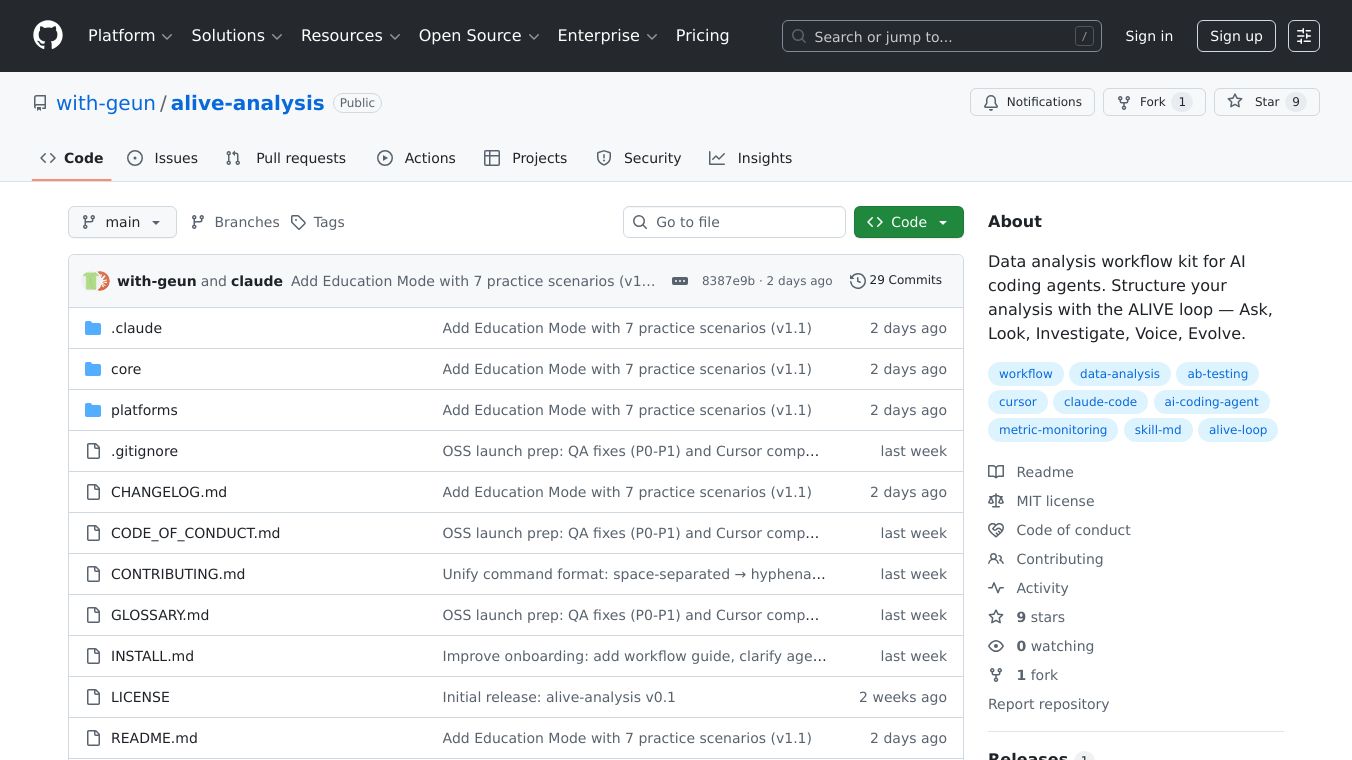





Thealive-analysisproject offers a structured way to work with AI for data analysis. It helps AI agents go beyond just giving quick answers and become partners in understanding data. The system uses a process called the ALIVE loop, which stands for Ask, Look, Investigate, Voice, and Evolve. This method ensures that analyses are thorough and repeatable. All the work done is saved as markdown files that are tracked by Git, making them easy to find and use again. This tool works with Claude Code and Cursor 2.4 or newer versions. It is also free to use and open source.
The main reasonalive-analysiswas created is to solve the problem of important insights getting lost in chat history. It also addresses how AI analyses can sometimes be done without a clear plan. By using the structured ALIVE loop, the tool helps maintain a high quality of analysis. It also builds a record of the thinking process that can be searched later. Checklists are included in each step to make sure important checks are not missed, like considering other factors or doing sensitivity tests. The tool also makes it easier for teams to work together by allowing them to share documents that have different versions and to send messages that are suited for different people.
The ALIVE loop has five stages:
- ASK: This is where you define the question you want to answer, the scope of your analysis, a plan for exploring different ideas, and how you will know if you have succeeded.
- LOOK: Here, you examine the data, check its quality, break it down into smaller groups, and look for any factors that might affect your results.
- INVESTIGATE: In this stage, you test your ideas, run analyses, and use different ways to look at the problem.
- VOICE: This is about sharing what you found. It includes explaining what the findings mean and what actions should be taken, making sure the message is clear for whoever is listening.
- EVOLVE: This final step involves figuring out what questions to ask next, planning future actions, tracking the results of those actions, and thinking about how the process went.
alive-analysishas two ways to work: Full mode, which is for detailed analyses with many files and checklists, and Quick mode, which is faster and can switch to Full mode if the analysis becomes more complex. It can handle three types of analysis: Investigation, which explores why something happened; Modeling, which is for making predictions; and Simulation, which looks at what-if scenarios. It also has features for A/B testing, keeping an eye on important metrics, searching for insights, and automatically reviewing past work.
There is also an Education Mode that helps users learn how to think about data analysis. It guides them through seven practice scenarios of different difficulty levels. Users can go through these scenarios, get scores based on a set of criteria, and receive hints as they learn. Completing these educational scenarios can help prepare users for doing real-world analysis using a specific command.
It is important to know thatalive-analysisis not a tool for creating visual dashboards, a library for doing statistics, or a system that analyzes data all by itself. Instead, it provides a framework and a process. Users still need to use their knowledge of the subject and their judgment to analyze the data. Teams can use this tool for different tasks, such as quickly looking into why a metric dropped, testing ideas for new features, and doing deep dives for important decisions. Some examples of how it has been used include looking into metric changes, reviewing tests, and creating documents for decisions.
This content is either user submitted or generated using AI technology (including, but not limited to, Google Gemini API, Llama, Grok, and Mistral), based on automated research and analysis of public data sources from search engines like DuckDuckGo, Google Search, and SearXNG, and directly from the tool's own website and with minimal to no human editing/review. THEJO AI is not affiliated with or endorsed by the AI tools or services mentioned. This is provided for informational and reference purposes only, is not an endorsement or official advice, and may contain inaccuracies or biases. Please verify details with original sources.

Comments
Please log in to post a comment.