Airtools





Airtool: A Supervised Runtime for the Agentic Enterprise
Overview
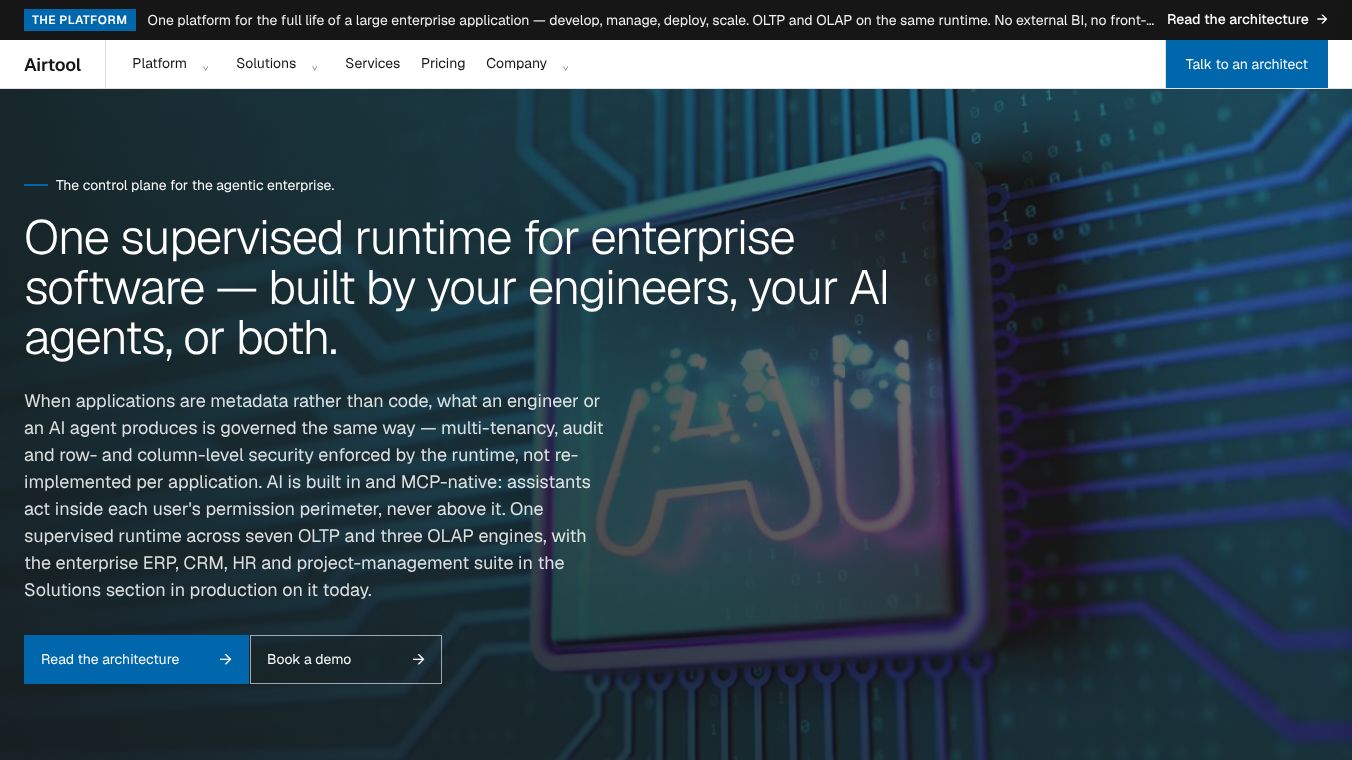
Airtool is a unified platform designed for the full lifecycle of large enterprise applications. It enables development, management, deployment, and scaling in one place. Unlike traditional systems that separate transactional and analytical workloads, Airtool supports both Online Transaction Processing and Online Analytical Processing on the same runtime. This eliminates the need for external Business Intelligence tools or custom front-end code. Positioned as the control plane for the agentic enterprise, Airtool serves as a single supervised runtime for enterprise software built by engineers, AI agents, or both.
Benefits
Airtool offers several key advantages over traditional platforms. It treats applications as metadata rather than static artifacts. This allows for dynamic materialization where endpoints, screens, triggers, and roles are defined as SQL rows within a metadata repository and materialized live by the runtime. Changes propagate cluster-wide in milliseconds via Redis pub/sub, allowing for instant updates without JARs or redeploys. The platform is multi-tenant by construction. Tenant boundaries are enforced at the JDBC layer rather than within application code, ensuring that each company within an installation has its own data, security perimeter, and audit trail.
Airtool addresses both transactional and analytical workloads natively on the same runtime, removing the need for data duplication or complex ETL pipelines. It supports native SQL generation for PostgreSQL, Informix, Oracle, DB2, SQL Server, MySQL, and SAP HANA for transactional workloads. For analytical workloads, it natively supports Vertica, ClickHouse, and BigQuery. The application automatically selects the engine best suited for its workload, and the compiler emits engine-native SQL regardless of the target.
The platform is built to integrate seamlessly with modern AI agents and Large Language Models. It abstracts across six major AI providers including OpenAI, Anthropic, Ollama, Google Vertex, IBM Watson, and Cohere. It includes native Retrieval-Augmented Generation capabilities, supporting customer choices for vector stores such as Qdrant, Milvus, PostgreSQL pgvector, or Redis. As a native Model Context Protocol server, AI assistants operate strictly inside each user's permission perimeter. They never exceed user permissions, ensuring governance and security are maintained even when AI agents interact with the system.
Airtool Studio centralizes every runtime concern into a single governed surface, reducing operational complexity. Servers, databases, users, roles, certificates, AI providers, cron jobs, integrations, and audit logs are managed from one interface. Eight different authentication mechanisms are unified under a single dispatcher. Instead of relying on external Application Performance Monitoring tools with separate licensing, Airtool offers in-memory MemDB. Observability is queryable directly via SQL, providing deep insights without additional costs.
Use Cases
Airtool is designed for the full lifecycle of large enterprise applications. It hosts a comprehensive business suite including ERP, CRM, HR, and project management applications at customer sites today. This suite runs alongside bespoke customer applications engineered on the same runtime. The platform supports a non-stop life cycle where new metadata, screens, and logic propagate without requiring a deployment window. There is no Kubernetes orchestration layer or service-mesh sidecar required. Nodes are stateless, and adding capacity is as simple as adding a node.
The platform is ideal for organizations seeking a unified approach to handling both transactional and analytical data. It is suitable for companies that want to leverage AI agents within their enterprise systems while maintaining strict security and governance controls. The metadata-driven architecture makes it perfect for environments that require frequent updates and instant propagation of changes across the cluster. Organizations looking to avoid vendor lock-in and external dependencies for Business Intelligence will find Airtool a robust foundation for the modern agentic enterprise.
Pricing
Pricing details are not available in the provided information.
Vibes
Public reception and specific reviews are not available in the provided information. However, the platform demonstrates credibility through its current production usage. The runtime hosts a comprehensive business suite at customer sites today, proving its reliability in real-world enterprise environments.
Additional Information
Airtool represents a shift toward a source-available, multi-tenant enterprise platform where the engineering platform itself is accessible to customers. By combining metadata-driven development, native support for diverse database engines, deep AI integration, and a unified operational cockpit, it provides a robust foundation for the modern agentic enterprise. The platform distinguishes itself from vendors like SAP, Salesforce, or Oracle, which keep their engineering platforms internal and sell extensions. Airtool inverts this model. The runtime that powers Airtool's own business suite is the same runtime customers use to build their own enterprise applications. The platform supports four server-side languages including JavaScript, Python, Groovy, and 4GL. It includes 18 specialized microservices in the runtime mesh and 40+ namespaces in the platform's standard library covering database, HTTP, AI, crypto, and documentation.
This content is either user submitted or generated using AI technology (including, but not limited to, Google Gemini API, Llama, Grok, and Mistral), based on automated research and analysis of public data sources from search engines like DuckDuckGo, Google Search, and SearXNG, and directly from the tool's own website and with minimal to no human editing/review. THEJO AI is not affiliated with or endorsed by the AI tools or services mentioned. This is provided for informational and reference purposes only, is not an endorsement or official advice, and may contain inaccuracies or biases. Please verify details with original sources.



Comments
Please log in to post a comment.