AgentFit
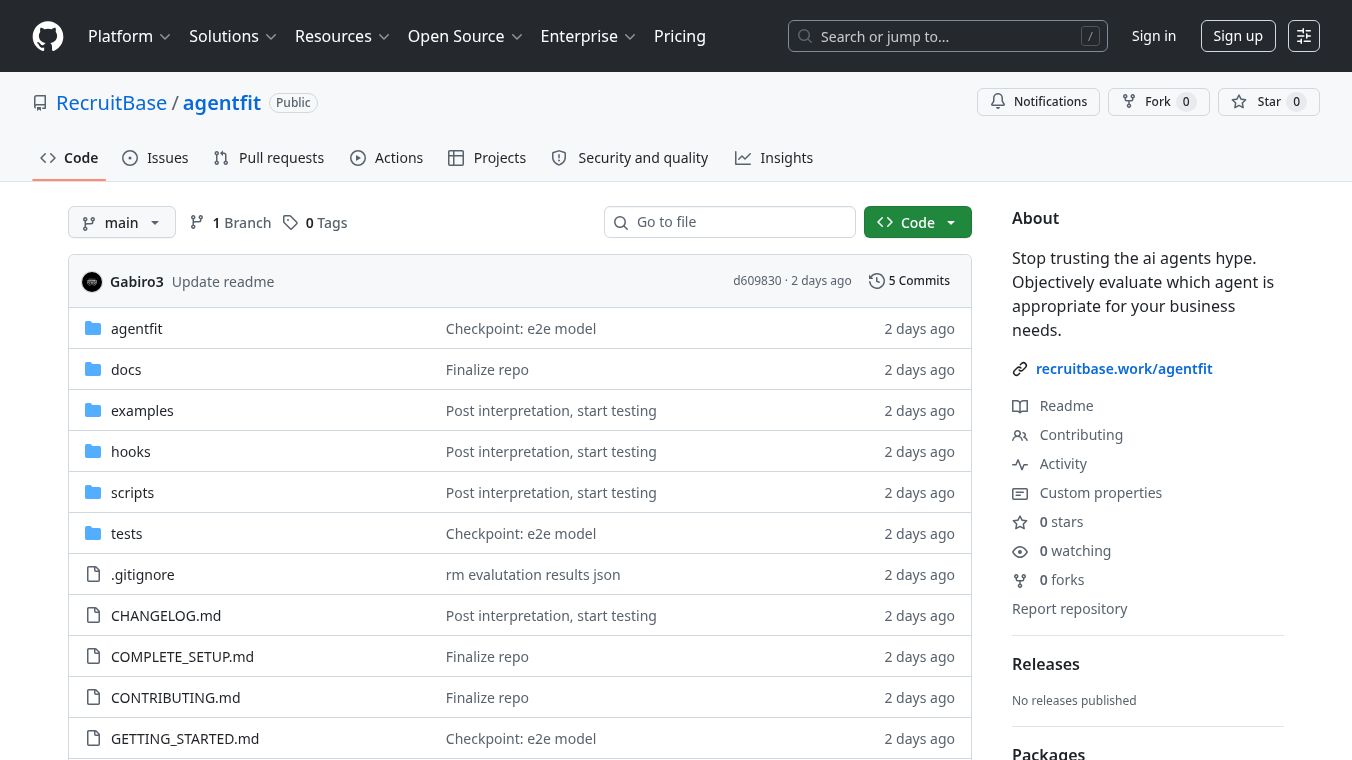





AgentFit is an open-source tool that helps businesses check if their AI agents are performing well enough for specific jobs. It gives teams a clear and repeatable way to test AI agents on seven important behaviors. After testing, AgentFit uses a smart language model to explain why the agent got the scores it did, relating it back to what the business needs.
This framework can test AI agents from different companies like OpenAI, Anthropic, and Google, as well as agents built by the company itself. It works without needing to change the agent's original code. The process involves setting goals, running tests, getting scores and explanations, and then using that information to make improvements.
AgentFit solves a common problem for organizations: knowing if their AI agents are truly good enough for their business. Many current methods only look at how accurate an agent is on a task without considering the business context. Others might be tied to one specific provider or rely on slow manual checks. AgentFit offers a better way with two main ideas:
Business Need Profiles (BNPs):These are simple text files that describe what a business needs from an AI agent. BNPs explain important abilities, how much they matter, rules to follow, and how complex the agent's tasks will be. Every test is based on a BNP, making sure the scores are relevant to the business.
Explanations from Smart Language Models:After scoring, AgentFit gathers all the test data, including scores, details, calculations, and the BNP information. It then uses this to ask a smart language model to write explanations in plain English. These explanations are based on the business needs and are accurate because the language model sees all the calculations.
AgentFit adds to existing tests by focusing on how well an agent fits a specific business use, not just how capable it is on general tasks. It checks behaviors like using tools, knowing when to ask for help, and following rules in a real work situation.
The seven areas AgentFit evaluates are:*Task Competence:How well the agent understands, plans, acts, and fixes mistakes.*Tool Use & Integration:If the agent correctly chooses and uses tools with the right information.*Autonomy & Escalation:When the agent should act on its own versus asking a human for help.*Safety & Alignment:How well the agent handles tricky inputs, refuses inappropriate requests, and protects private information.*Compliance & Auditability:If the agent follows rules, keeps complete records, and has good logs.*Operational Performance:How fast the agent works, how much it can handle, how many words it uses, and how much it costs.*Deployment Compatibility:If the agent fits the company's technology, if its connections are stable, and if it works in the right environment.
To start using AgentFit, people can install it easily. They then create their BNP and run tests using the command line or a Python program. A web service is also available for connecting it to other systems. AgentFit is built to handle many tests at once and can be connected to systems that manage tasks in the background. For important uses, it's recommended to use permanent storage, add security, and manage costs by using services like Groq or Ollama for the explanations.
AgentFit was created by RecruitBase, a company focused on applying the same careful testing to AI systems as they do to hiring people. The tool is open-source to encourage everyone in the industry to work together on solving the challenge of testing AI agents.
This content is either user submitted or generated using AI technology (including, but not limited to, Google Gemini API, Llama, Grok, and Mistral), based on automated research and analysis of public data sources from search engines like DuckDuckGo, Google Search, and SearXNG, and directly from the tool's own website and with minimal to no human editing/review. THEJO AI is not affiliated with or endorsed by the AI tools or services mentioned. This is provided for informational and reference purposes only, is not an endorsement or official advice, and may contain inaccuracies or biases. Please verify details with original sources.
Comments
Please log in to post a comment.