Agent-Eval
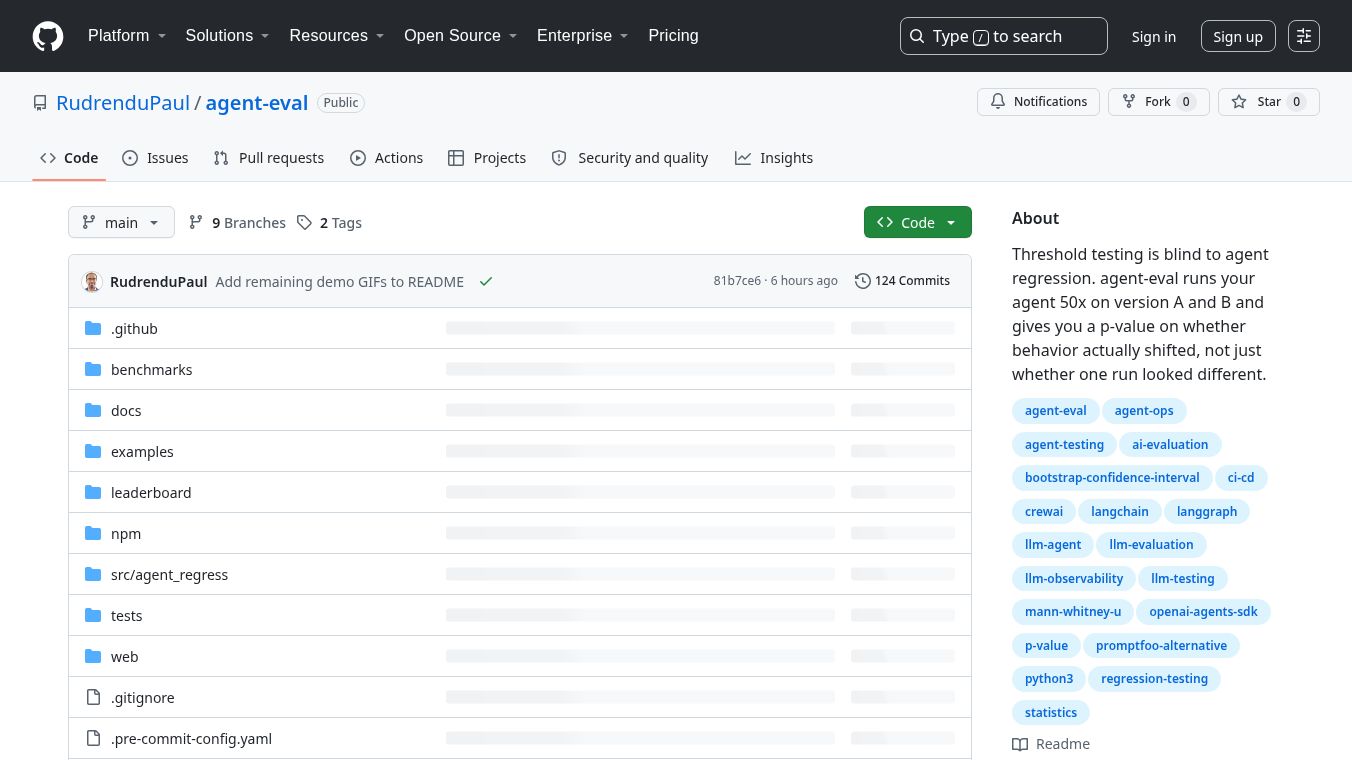





Agent Evaluation: Statistical Regression Testing for LLM Agents
Introduction
Agent Evaluation is a tool designed to help developers test and compare the performance of AI agents. Unlike traditional methods that only check if a single answer is good enough, this tool looks at how an agent performs over many tries. It helps teams know if a change to their AI system, like updating a prompt or switching models, actually makes the agent better or worse. It does this by using statistical tests to separate real performance changes from random noise.
Benefits
Agent Evaluation offers several key advantages for teams building AI applications. First, it solves the problem of missing real drops in quality. Standard tests might pass even if an agent gets worse because individual answers still look okay. Agent Evaluation detects shifts in the overall behavior of the agent. Second, it uses advanced statistics to give clear answers. It combines a p-value, confidence intervals, and effect size to tell you if a change is significant and meaningful. Third, it is fast and easy to use. The statistical calculations take only milliseconds, so they do not slow down your testing process. Finally, it integrates with popular AI frameworks like LangGraph and CrewAI, making it simple to add to existing workflows.
Use Cases
This tool is useful for anyone who builds or manages AI agents. Developers can use it to compare two versions of an agent before releasing a new one. For example, a team can run their old agent and new agent on the same set of tasks fifty times each. The tool then tells them if the new version is stable or if it has regressed. It is also great for continuous integration pipelines. Teams can set it up to automatically fail a build if a code change causes the agent to perform worse. Researchers can use it to test how reliable an agent is over multiple attempts. It also helps in benchmarking by providing standard tests for different difficulty levels.
Pricing
Agent Evaluation is open source and free to use. It is licensed under the Apache License 2.0, which allows commercial use, modification, and distribution. There are no hidden costs or subscription fees. You can install it as a command-line tool or a Python library without paying anything.
Vibes
The tool has received positive attention from the developer community for solving a critical gap in AI testing. Users appreciate its ability to provide clear verdicts like REGRESSED, IMPROVED, or STABLE. The output is easy to read and includes all the necessary data points like p-values and confidence intervals. Developers find the integration with major frameworks like LangChain and OpenAI Agents SDK very helpful. The tool is seen as a reliable way to ensure that AI systems remain stable as they evolve.
Additional Information
Agent Evaluation was built by Rudrendu Paul and Sourav Nandy. It is available on GitHub at RudrenduPaul/agent-eval. The project focuses on statistical regression testing specifically for Large Language Model agents. It includes built-in scorers for exact match and F1 scores but allows users to create their own custom scoring functions. The tool is designed to be secure and follows best practices for software supply chains, including code signing and vulnerability scanning. It is currently available for LangGraph, OpenAI Agents SDK, CrewAI, and LangChain, with plans to support AutoGen and Vercel AI SDK in future updates.
This content is either user submitted or generated using AI technology (including, but not limited to, Google Gemini API, Llama, Grok, and Mistral), based on automated research and analysis of public data sources from search engines like DuckDuckGo, Google Search, and SearXNG, and directly from the tool's own website and with minimal to no human editing/review. THEJO AI is not affiliated with or endorsed by the AI tools or services mentioned. This is provided for informational and reference purposes only, is not an endorsement or official advice, and may contain inaccuracies or biases. Please verify details with original sources.


Comments
Please log in to post a comment.