




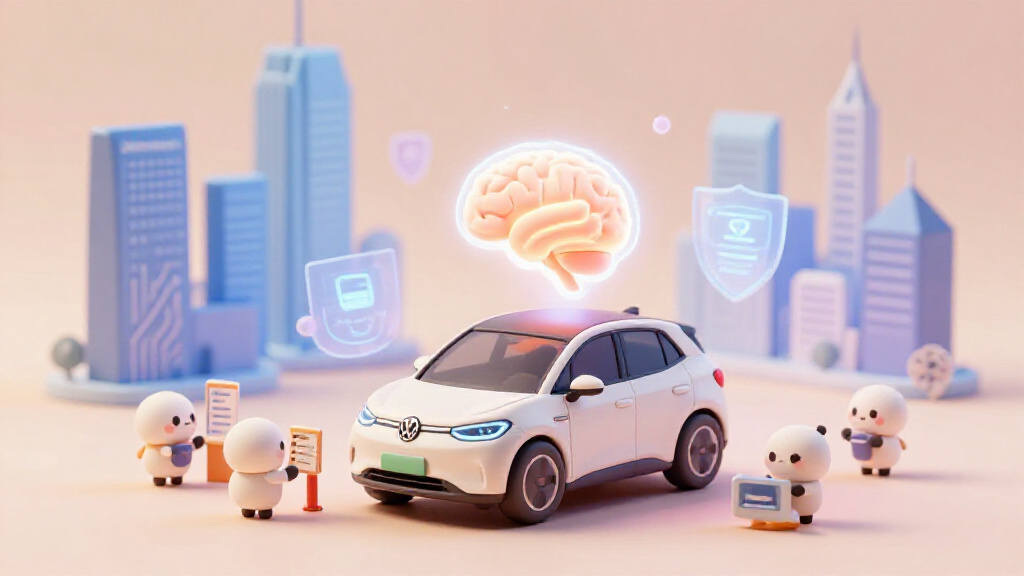
Volkswagen is aggressively entering the Chinese market with a new AI strategy, launching agentic AI systems in vehicles starting the second half of 2026. These onboard agents, powered by locally trained large language models, will handle complex tasks like restaurant reservations and parking without relying on the cloud. The system integrates technology from Tencent, Alibaba, and Baidu to create a personalized companion interface, marking a significant shift in how the automaker approaches electric vehicle sales in the region.
While automotive giants push forward, the financial sector is pouring billions into AI infrastructure. Global financial AI spending is projected to reach $97 billion by 2027, up from $35 billion in 2023. Major banks like JPMorgan Chase and Goldman Sachs are integrating these tools for fraud detection and trading, yet only 29 percent of institutions have a formal AI roadmap. The industry faces challenges regarding the transparency of black box systems and the risk of regulatory penalties from full-scale automation.
Security experts warn that 72% of enterprises lack real control over their AI platforms, creating a governance mirage despite using tools from Microsoft, Google, and OpenAI. This disconnect forces companies to build custom control planes to manage multiple agents and protect data privacy. Meanwhile, Hollywood directors like Steven Soderbergh are adopting AI for production, viewing it as a tool to augment human creativity rather than replace it, similar to the shift to digital cameras.
Amidst these developments, Sam Altman of OpenAI emphasizes the high stakes of the current AI race, warning that falling behind could have long-term consequences for national security and economic prosperity. A new documentary, 'The AI Doc,' explores these dualities, advocating for guardrails to ensure AI benefits humanity. In education, student Alessa Carbo exemplifies the talent pipeline, teaching herself coding and joining Johns Hopkins' AI Safety Institute to work on deep learning models for sign language processing.
Key Takeaways
['Volkswagen plans to launch locally trained AI agents in Chinese vehicles starting the second half of 2026.', 'Global financial AI spending is projected to reach $97 billion by 2027, up from $35 billion in 2023.', 'Only 29 percent of financial institutions currently have a formal AI roadmap despite heavy investment.', '72% of enterprises claim to use multiple AI platforms but lack real control and security.', 'Hollywood directors like Steven Soderbergh are embracing AI to augment human creativity in film production.', 'Sam Altman warns that falling behind in AI development poses significant risks to national security and economic prosperity.', "A new documentary titled 'The AI Doc' advocates for establishing guardrails to manage AI's potential risks.", 'Student Alessa Carbo is working on AI safety research at Johns Hopkins University.', "Volkswagen's new AI system integrates technology from Tencent, Alibaba, and Baidu for in-car interactions.", 'Banks remain cautious about full-scale AI deployment due to concerns over transparency and regulatory compliance.']Volkswagen launches agentic AI in China cars this year
Volkswagen Group plans to equip new vehicles built for China with AI agents starting in the second half of 2026. These onboard AI agents will allow for highly intuitive, human-like interactions between the car and the driver while ensuring robust personal data protection. Unlike simple voice assistants, these AI agents can handle complex tasks such as searching for restaurants, making reservations, and organizing parking. The technology uses a locally trained large language model that runs entirely on the car rather than the cloud. Volkswagen CEO Oliver Blume stated this move signals the company is back with a China-specific electric and intelligent vehicle strategy.
Volkswagen adds voice-controlled AI to Chinese cars
Volkswagen announced it will incorporate AI voice commands into its cars for the Chinese market starting in the second half of 2026. The in-car AI agent will draw on technology from Tencent, Alibaba, and Baidu to create a tool with personality that can anticipate a driver's needs. The system uses a locally trained large language model that runs entirely on the vehicle instead of the cloud. Volkswagen revealed four new cars in Beijing, including the ID. UNYX 09, which the company co-developed with EV maker Xpeng. This move is part of the company's strategy to recoup lost market share as China rapidly turns to electric vehicles. Volkswagen has invested heavily in China with stakes in Xpeng and automotive chipmaker Horizon Robotics.
Volkswagen deploys AI voice assistants in China cars
Volkswagen is adding AI voice assistants to every model built on its China car platform starting this year. The AI agent draws on technology from Tencent, Alibaba, and Baidu and runs locally on the car rather than the cloud. Voice commands will be the primary interface for these agents, which are designed to anticipate what drivers want with a distinct sense of personality. Volkswagen China CTO Thomas Ulbrich described the assistant as a companion that helps with tasks like booking restaurants and parking. Looking ahead, a single agentic AI system is planned for launch next year to integrate both driver-assist functions and cockpit controls. The AI push is part of Volkswagen's broader effort to recover market share in China as the country shifts toward electric vehicles.
72% of enterprises lack real AI control and security
A survey by VentureBeat reveals that 72% of organizations claim to have multiple primary AI platforms, yet they face significant gaps in security and control. These multiple platforms extend the attack surfaces of enterprises at a time when AI-driven attacks have become increasingly potent. The research highlights a strategic paradox where leading enterprises like Mass General Brigham rely on software giants like Microsoft, Google, and OpenAI, but must build workarounds for safety and data privacy. Even though these companies have resources, they often fail to provide enough control, forcing enterprises to create custom control planes to coordinate different agents. VentureBeat calls this situation a governance mirage because many enterprises lack clear accountability or specific guardrails.
Hollywood directors embrace AI for film production
Respected Hollywood directors like Steven Soderbergh, James Cameron, and Sandra Bullock are now embracing artificial intelligence in their film production. Soderbergh mentioned his interest in using AI for his Spanish-American war movie, noting that the tech can augment the work of technicians without being purely generative. Other powerful names in Hollywood have also sounded ready to embrace AI, often in language that sounds like a corporate spokesperson. While some directors like Guillermo del Toro remain skeptical, others see AI as a tool that can look invisible when given the proper time and human touch. The article compares this shift to the introduction of digital cameras, noting that while some holdouts remain, the technology is becoming standard. Experts suggest that in a few years, people may say similar things about AI as they did about digital cameras.
Webinar explores trust dilemmas in AI security
Ping Identity experts are hosting a webinar to explore the current state of trust in the age of AI, drawing on research from over 700 IT decision-makers. The session examines how cybercriminals use AI for advanced identity fraud and deepfakes, as well as the rise of AI agents that differ from adversarial bots. The webinar also covers the identity management gap where traditional methods fall short in securing non-human identities and cross-system workflows. Participants will learn about strategic security frameworks like Zero Trust, ephemeral access, and dynamic entitlements to mitigate AI-specific risks. The goal is to help professionals stay ahead of AI-based threats while building infrastructure to securely harness the power of autonomous digital workers.
PDD Day bans AI tools for writing stories
Perfect Duluth Day has issued a policy stating it does not approve of using artificial intelligence tools to write stories. While spelling and grammar-checking software often rely on technologies that mimic human intelligence, the event aims for accuracy and text that is pleasant to read. If the writing technique is poor or the information is incorrect, PDD will reject the post regardless of whether a bot or a human created it. For images, the organization prefers unaltered photography and graphics created by human artists. On rare occasions when AI is used to clean up historical photos or perform graphic tasks, the policy requires noting it in the caption or adjacent text. Advertisements and promotional images are exceptions to this policy, and individual organizations must determine how to use images to promote their events.
Banks invest billions in AI but deployment remains cautious
Banks are investing billions in artificial intelligence for fraud detection, customer service, and trading analytics, yet full-scale deployment remains cautious. The World Economic Forum projects global financial AI spending to reach $97 billion by 2027, up from around $35 billion in 2023. Large institutions like JPMorgan Chase and Goldman Sachs have integrated AI into their workflows to improve productivity and reduce labor-intensive tasks. However, only 29 percent of financial-services sector respondents had a formal AI roadmap in mid-2024. Chief among the challenges is the need for transparency, as the opacity of black box AI systems makes it difficult to explain outputs to regulators and customers. Banks are wary of deploying automation at full scale due to the risk of errors, regulatory penalties, and reputational damage.
New documentary examines AI promises and risks
The new documentary 'The AI Doc: Or How I Became An Apocaloptimist' explores the many promises of artificial intelligence and its potential dark sides. The film advocates for people to understand AI so they can put up guardrails to prevent the worst outcomes and foster the best. It highlights that this rapidly developing technology can be both good for life and humanity and bad for it. The documentary aired on April 21, 2026, on 'Here & Now' with host Scott Tong speaking to the film's co-director. The film aims to help viewers recognize that AI requires careful management to ensure positive results for society.
Student teaches herself coding at Johns Hopkins
Alessa Carbo taught herself programming and machine learning after growing up in Cabo San Lucas, Mexico, which had no library or computer science classes. She attended Johns Hopkins University to study computer science and joined the Center for Language and Speech Processing to explore natural language processing research. In the summer of 2024, she participated in the center's annual summer research program working on deep learning models for sign language processing. Her research focus has since shifted towards AI safety, leading her to join the highly selective Hopkins AI Safety Institute. She has traveled to conferences in China, Austria, the Czech Republic, and across the U.S. This year alone, she has been to many international events. Carbo credits her mentors, family, and the support at Johns Hopkins for making her research experience meaningful.
Sam Altman warns of high stakes in AI race
Sam Altman, CEO of OpenAI, recently shared his perspectives on the accelerating pace of artificial intelligence development and its profound implications for global competition. Altman views the current period as a critical juncture where the pace of innovation directly influences a nation's ability to maintain a competitive advantage. He stated that falling behind in AI development could have significant, long-term consequences for economic prosperity and national security. Altman explicitly connects AI development to broader economic and geopolitical shifts, noting that advanced AI systems have the potential to dramatically alter economies. He argues that AI will reshape the global economy in ways that are hard to imagine, creating new industries while potentially displacing labor. The concentration of advanced AI capabilities could exacerbate existing power imbalances or create new ones in the coming decades.
Sources
- Volkswagen Group announces AI roadmap in China to equip vehicles with 'agentic AI'
- Volkswagen announces voice AI in its Chinese cars from later this year
- Volkswagen is adding AI voice assistants to its China-market cars this year
- The AI governance mirage: Why 72% of enterprises don’t have the control and security they think they do
- Why are respected film-makers suddenly embracing AI?
- AI & The Trust Dilemma
- PDD Shop Talk: Artificial Intelligence Policy
- Banks Are Investing Heavily in AI, So Why Is Deployment Still Somewhat Cautious?
- 'AI Doc' explores promises and risks of rapidly developing artificial intelligenc
- A student's path to publishing
- Sam Altman on AI's Future & Global Competition
Comments
Please log in to post a comment.