




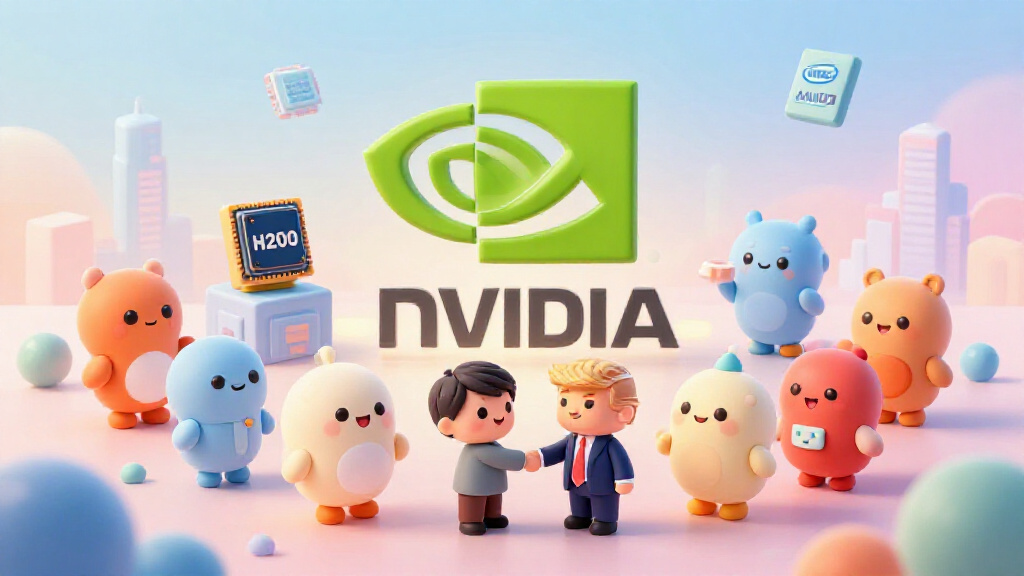
Nvidia's market value surged to $5.7 trillion after the U.S. government approved sales of its H200 AI chips to 10 major Chinese firms, including Alibaba, Tencent, and ByteDance. This approval, which allows Nvidia to receive 25 percent of the revenue from these specific transactions, follows a visit by CEO Jensen Huang to Beijing with President Donald Trump. Investors are now anticipating Nvidia's May 20 results, expecting revenue to reach $78.8 billion.
Despite the U.S. clearance, Chinese authorities have not yet allowed the chips to be shipped, citing a preference for domestic alternatives like those from Huawei Technologies. Senate Minority Leader Chuck Schumer criticized the move, arguing that selling advanced chips to firms linked to the military threatens America's lead in the global AI race. Analysts suggest Trump may be prioritizing Nvidia's interests over national security concerns.
While Nvidia dominates headlines, other tech sectors are also shifting. Cerebras saw its shares jump 70 percent on its first day of trading, reaching a $95 billion market value with its Wafer Scale Engine chip. Meanwhile, Intel, AMD, and Broadcom have driven a rally that leaves half of the S&P 500 behind, as private credit firms pour money into AI infrastructure.
AI's impact extends beyond hardware and stock markets. Research indicates that firing workers after launching AI projects does not improve financial returns; instead, companies should focus on training existing staff. In the energy sector, S&P Global launched HorizonsAgents to help clients make faster sustainability decisions, while UK regulators warn that AI tools could supercharge cyberattacks, threatening financial stability.
Key Takeaways
["Nvidia's market value reached $5.7 trillion following U.S. approval for H200 chip sales to 10 Chinese companies.", 'The U.S. government will receive 25 percent of revenue from the approved Nvidia sales to Chinese firms.', 'Investors expect Nvidia to report $78.8 billion in revenue during its May 20 earnings call.', 'Chinese authorities have stalled H200 chip shipments despite U.S. approval, prioritizing local chipmaker Huawei.', 'Senate Minority Leader Chuck Schumer warned that selling H200 chips to China threatens U.S. AI leadership.', 'Cerebras shares rose 70 percent on its IPO debut, valuing the company at $95 billion.', 'Research shows 80 percent of large companies cut jobs at the same rate regardless of AI project success.', 'Intel, AMD, and Broadcom led a stock rally that left 52 percent of S&P 500 stocks below their 50-day moving averages.', 'UK regulators warned that AI tools could enable faster and cheaper cyberattacks against financial systems.', 'S&P Global launched HorizonsAgents to integrate AI into its energy and sustainability data platforms.']Nvidia Reaches $5.7 Trillion Value After China Sales Approval
Nvidia's market value hit $5.7 trillion after its shares rose nearly 4 percent. The U.S. government approved about 10 Chinese companies to buy Nvidia's H200 AI chips. This move signals a possible shift in export rules for high-tech goods. Investors are waiting for Nvidia's results on May 20, expecting $78.8 billion in revenue. The approval aims to boost Nvidia's sales and investment in China's AI sector.
Schumer Calls Trump's Nvidia Chip Plan Dangerous for US
Senate Minority Leader Chuck Schumer criticized President Donald Trump for allowing Nvidia to sell H200 AI chips to Chinese firms linked to the military. Schumer said giving China this technology threatens America's lead in the global AI race. Despite U.S. approval, Chinese authorities have not allowed the chips to be shipped yet. They are prioritizing their own chipmaker, Huawei Technologies. Analysts worry Trump is putting Nvidia's interests ahead of national security.
US Clears Nvidia H200 Sales to 10 Chinese Tech Giants
The U.S. government approved 10 major Chinese firms to purchase Nvidia's H200 AI chips. The approved buyers include Alibaba, Tencent, ByteDance, Lenovo, and Foxconn. Nvidia CEO Jensen Huang recently visited Beijing with President Donald Trump to discuss this deal. Although the U.S. cleared the path, no chips have been delivered because Beijing is encouraging companies to use local chips instead. The U.S. government will receive 25 percent of the revenue from these specific sales.
US Approves Chinese Firms to Buy Nvidia H200 Chips
The U.S. government approved several Chinese companies to buy Nvidia's powerful H200 AI chips. The approved buyers include Alibaba, Tencent, ByteDance, and JD.com. This decision comes as the U.S. tightens restrictions on advanced technology exports to China. The H200 chip is used for artificial intelligence, machine learning, and data analytics. Beijing has shown hesitation and has stalled all transactions so far. The move is seen as a way to limit China's ability to develop its own AI capabilities for military use.
Nutriband Plans to Sell AI Wellness Products at Walmart
Nutriband Inc. announced its subsidiary, Active Intelligence, will meet with Walmart and other major retailers in June 2026. They plan to showcase AI Performance Tape, AI Energy Patches, and AI Sleep products. These new items are designed to help with athletic recovery, daily energy, and better sleep. The company hopes these products will lead to new retail partnerships across North America. Nutriband is also developing an abuse-deterrent fentanyl patch using its AVERSA technology.
Nutriband Subsidiary to Show AI Wellness Products at ECRM
Nutriband's subsidiary, Active Intelligence, will present its wellness products at the June 2026 ECRM conference. The showcase will include AI Tape, AI Performance Tape, AI Energy Patches, and AI Sleep. This event connects suppliers with buyers from major retail and healthcare organizations. The move helps Nutriband diversify beyond its pharmaceutical products into the consumer health market. Active Intelligence aims to secure placement in large retail chains to broaden its customer base.
AI Layoffs Do Not Improve Business Returns
Research shows that firing workers after launching AI projects does not lead to better financial returns. Eighty percent of large companies cut jobs at the same rate regardless of their AI success. Experts say companies should invest in training employees instead of replacing them. The best results come from giving workers AI tools to do more with their existing knowledge. Cutting staff removes the expertise needed for AI systems to work properly.
Cerebras IPO Highlights US Tech Race with China
Cerebras, an AI chipmaker, saw its shares rise 70 percent on its first day of trading. The company now has a $95 billion market value. Its Wafer Scale Engine chip is much larger and more powerful than Nvidia's flagship chip. The IPO is significant because it shows American companies building the hardware needed to compete with China. Cerebras also has strong ties to customers in the Middle East, which helps expand U.S. technology influence in the region.
AI Chip Rally Leaves Half of S&P 500 Behind
The recent rise in stock prices is driven almost entirely by AI chip companies. Intel, AMD, and Broadcom have seen huge gains, but other sectors are struggling. Only 52 percent of S&P 500 stocks are trading above their 50-day moving averages. This means half of the market is being left behind by the AI boom. Private credit firms are also investing heavily in AI infrastructure, deepening the focus on this specific sector.
UK Regulators Warn Firms About AI Cyber Risks
British officials warned companies to plan for risks from new artificial intelligence models. The finance ministry, Bank of England, and Financial Conduct Authority issued a joint statement. They said current AI tools can perform cyberattacks faster and cheaper than skilled humans. If used maliciously, these tools could threaten financial stability and customer safety. Experts are concerned about a specific AI tool called Mythos that could supercharge cyberattacks.
Binance Chief Discusses AI Security and Crypto Growth
Jimmy Su, Chief Security Officer at Binance, discussed how AI is changing crypto security. He noted that attackers use AI to find vulnerabilities much faster than before. However, defenders can also use AI to spot and stop attacks early. Binance is adding new features like oil trading contracts to attract traditional investors. The company sees a long-term future for crypto adoption in rural areas and asset tokenization.
S&P Global Launches New AI Energy Tools
S&P Global launched HorizonsAgents, a suite of AI tools for energy and sustainability. These tools are integrated into its Capital IQ Pro platform to help clients make faster decisions. The new features turn complex energy data into audit-ready outputs for banks and investors. This move reinforces S&P Global's role in providing data for the energy transition. Investors are watching to see if these AI tools will create new value without hurting profit margins.
Contract Rules for AI in Clinical Trials Explained
This article explains contract rules for using AI in clinical trials. It focuses on data rights, intellectual property, and regulatory compliance. Organizations must decide who owns the data inputs and the AI-generated outputs. Contracts need clear clauses about how data can be used to train or improve AI systems. Companies must also map all data the AI touches to ensure it is used correctly and securely.
Emanate Launches AI Platform for Industrial Sales
Emanate introduced a new AI sales platform for complex industrial materials. The system automates quote generation by matching technical specs with customer needs. It integrates engineering data to reduce manual work and errors in proposals. This tool is designed for sectors like aerospace and construction where detailed specifications are required. The platform aims to speed up negotiations and improve collaboration between sales and engineering teams.
Sources
- Nvidia hits $5.7T as U.S. clears China AI chip sales
- Chuck Schumer Says Trump's Plan To Sell AI Chips To Military-Linked Chinese Firms Is 'Dangerous' As Trump
- NVDA Stock Hovers Near $6 Trillion Market Cap, US Reportedly Clears Path for AI Chip Sales to China
- U.S. approves Chinese companies to buy Nvidia H200 AI chips
- Nutriband brings AI wellness tapes and energy patches to Walmart talks
- Nutriband Subsidiary Active Intelligence to Showcase Wellness Products at ECRM Conference
- AI-driven layoffs aren’t making business sense
- Why the hottest tech IPO of the year matters for the AI race with China and in the Middle East
- The AI Chip Rally Is Masking a Dangerous Truth. Half the S&P 500 Is Being Left Behind
- UK firms should take steps to limit risks from frontier AI models, UK says
- Crypto Adoption Meets AI Security: A Discussion with Binance Chief Security Officer Jimmy Su
- How S&P Global’s New AI Energy Suite Could Reshape S&P Global (SPGI) Investors’ Thesis
- Contracting For AI In Clinical Trials: Data Rights And Regulatory Compliance (Part 2)
- Sector-Specific Sales Assistants : ai sales platform
Comments
Please log in to post a comment.