




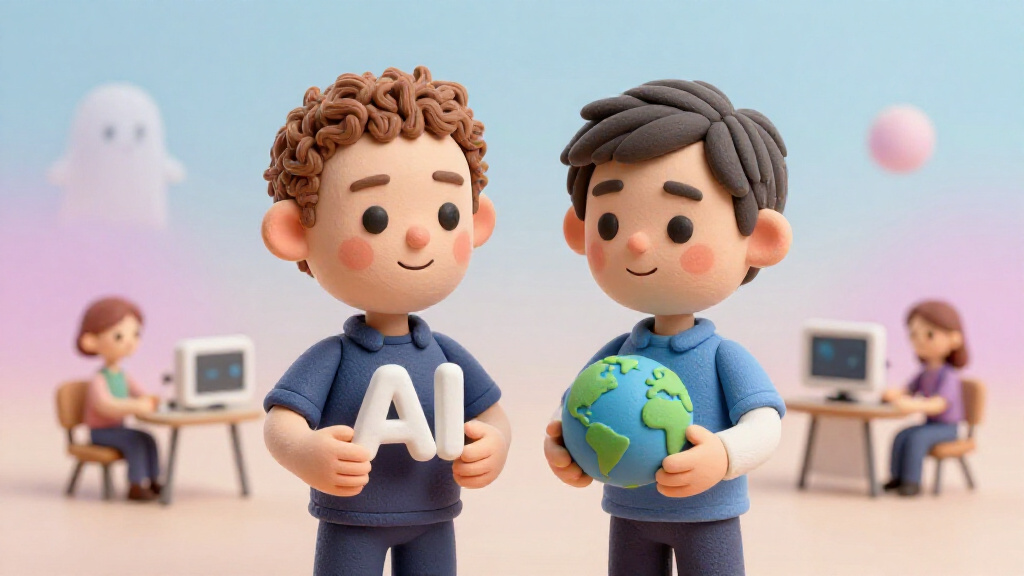
Mark Zuckerberg has published a new manifesto on the future of AI, envisioning a world where AI enhances human life. He sees AI as a tool to improve relationships, health, careers, and finances. Zuckerberg's vision includes personalized tutors and coaches, as well as tools for creation and entrepreneurship.
Zuckerberg's manifesto is not the only one from a tech leader. Sam Altman has also shared his vision for AI, emphasizing the need for AI to be developed and controlled by a few large companies. These manifestos reflect the growing influence of AI and the need for leaders to think critically about its role in society.
The use of AI in scientific discovery raises questions about who gets credit for the work. A recent example is the solution to the unit-distance conjecture, a mathematical problem that had stumped experts for decades. The solution was discovered by AI, but humans were also involved in guiding the search.
The rise of AI is threatening the software industry, particularly companies that rely on leveraged buyouts. AI has the potential to disrupt software providers, especially those focused on data visualization or tasks that can be replicated by AI models. Private equity firms that invest in these companies may face significant risks as AI technologies advance.
Indonesia has launched a new AI center, the UGM Indosat NVIDIA AI Technology Center, which aims to develop local AI talent and address the country's most pressing challenges. The center is a collaboration between the government, industry, and academia, and will provide access to enterprise-grade AI computing and software.
Key Takeaways
['Mark Zuckerberg publishes a manifesto on the future of AI, envisioning a world where AI enhances human life.', 'Sam Altman emphasizes the need for AI to be developed and controlled by a few large companies.', 'The use of AI in scientific discovery raises questions about who gets credit for the work.', 'The rise of AI threatens the software industry, particularly companies that rely on leveraged buyouts.', 'Indonesia launches a new AI center, the UGM Indosat NVIDIA AI Technology Center, to develop local AI talent.', 'AI has the potential to disrupt software providers, especially those focused on data visualization or tasks that can be replicated by AI models.', 'Private equity firms that invest in software companies may face significant risks as AI technologies advance.', 'The use of AI in court filings raises concerns about the potential risks of AI-generated content.', 'The dangers of AI, including job loss, inequality, and rogue agents, are becoming clearer every day.', 'A company called Joi AI conducts a study on the use of AI companions for masturbation, with participants reporting increased pleasure and satisfaction.']Zuckerberg's AI Future
Mark Zuckerberg has published a new manifesto on the future of AI, envisioning a world where AI enhances human life. He sees AI as a tool to improve relationships, health, careers, and finances. Zuckerberg's vision includes personalized tutors and coaches, as well as tools for creation and entrepreneurship. His goal is to make AI accessible to everyone, not just the wealthy. He also emphasizes the need for a balanced approach to AI development, considering both its potential benefits and risks.
Why Tech Leaders Are Writing AI Manifestos
Tech leaders like Mark Zuckerberg and Sam Altman are writing manifestos to share their visions for AI. These manifestos aim to shape the direction of AI development and address concerns about its impact on society. Zuckerberg's manifesto focuses on the potential benefits of AI, while Altman emphasizes the need for AI to be developed and controlled by a few large companies. These manifestos reflect the growing influence of AI and the need for leaders to think critically about its role in society.
Who Gets Credit When AI Helps?
The use of AI in scientific discovery raises questions about who gets credit for the work. A recent example is the solution to the unit-distance conjecture, a mathematical problem that had stumped experts for decades. The solution was discovered by AI, but humans were also involved in guiding the search. This raises questions about how to attribute credit and recognition in collaborative human-AI projects.
The Reality Check on AI
Mark Zuckerberg's AI manifesto has been met with skepticism by some, who question the feasibility of his vision. Roy Austin Jr., a former Meta executive, argues that Zuckerberg's words and actions don't align. He notes that Meta has cut its AI safety teams and prioritized efficiency over social responsibility. Austin calls for a more nuanced discussion about AI's potential risks and benefits.
AI Threatens Software Buyouts
The rise of AI is threatening the software industry, particularly companies that rely on leveraged buyouts. AI has the potential to disrupt software providers, especially those focused on data visualization or tasks that can be replicated by AI models. Private equity firms that invest in these companies may face significant risks as AI technologies advance.
Man Uses AI to Try to Win Court Case
A man representing himself in a lawsuit has been using AI to generate prompts in his court filings. The judge has expressed concerns about the use of AI in the case and has ordered the man to provide more information about his use of AI. This case highlights the growing concern about the use of AI in court filings and the potential risks of AI-generated content.
Indonesia Launches AI Center
Indonesia has launched a new AI center, the UGM Indosat NVIDIA AI Technology Center, which aims to develop local AI talent and address the country's most pressing challenges. The center is a collaboration between the government, industry, and academia, and will provide access to enterprise-grade AI computing and software.
Three AI Scenarios
There are three possible scenarios for the future of AI: AI replaces human dominance, AI controls humans indirectly, or humans and AI coexist under real human governance. The greatest threat from AI may not be an army of conscious robots, but the slow surrender of human control over the systems modern life runs on.
The Dark Side of AI
The dangers of AI, including job loss, inequality, and rogue agents, are becoming clearer every day. The US economy has lost jobs, and wage growth has slowed, with evidence suggesting that AI may be playing a role. There is a need for a more nuanced discussion about AI's potential risks and benefits.
AI for Pleasure
A company called Joi AI has conducted a study on the use of AI companions for masturbation, with participants reporting increased pleasure and satisfaction. The study raises questions about the potential benefits and risks of using AI companions for human relationships.
Sources
- Mark Zuckerberg’s Awkward Pivot to AI Optimism
- Why tech bosses keep sharing their manifestos about AI
- Who gets credit when AI joins the team? Rethinking collaboration.
- When an AI Manifesto Runs Into Reality
- AI Threatens Leveraged Software Buyouts
- Suspecting court of using AI, man injected prompts in filings to try to win case
- Universitas Gadjah Mada, Indosat and NVIDIA Open Indonesia’s First University AI Center to Develop Local AI Talent
- The Science of Fiction: Three AI Scenarios
- Lost jobs, inequality, rogue agents: why are we accepting oligarchs’ AI agenda?
- These ‘Masturbation Consultants’ Were Hired to Pleasure Themselves With AI
Comments
Please log in to post a comment.