




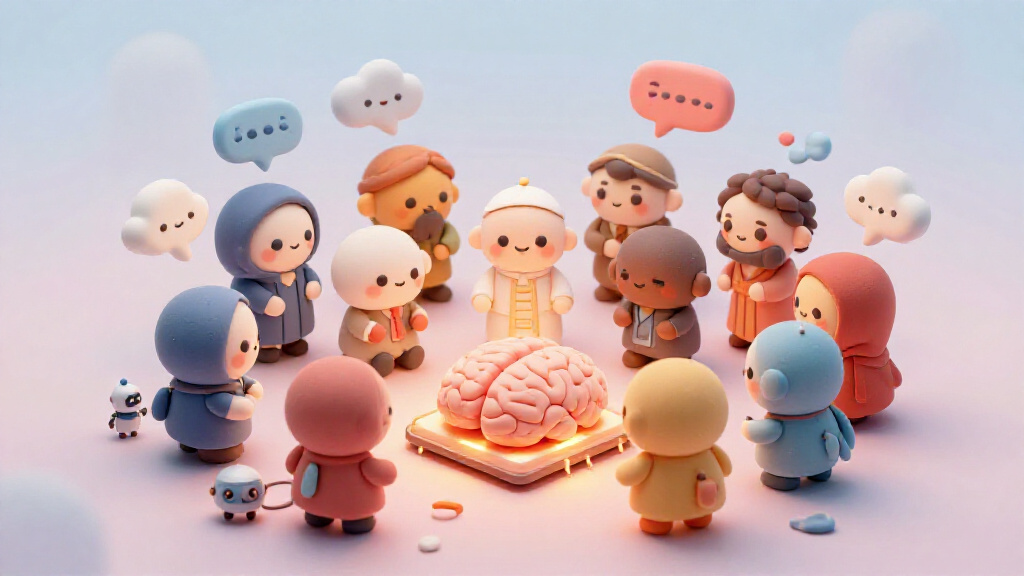
Pope Leo XIV has established a new study group within the Pontifical Academy of Sciences to examine the ethical and social impacts of artificial intelligence. This team of experts, including specialists in computer science, philosophy, and theology, will guide the Vatican's upcoming first encyclical dedicated to AI. Their work focuses on balancing technological advancement with human dignity, warning against letting algorithms control human lives for commercial goals.
While the Vatican explores these high-level ethical questions, practical concerns are emerging among workers globally. A recent CNBC survey reveals that 65% of workers have avoided using AI due to privacy worries, moral issues, and fears about job security or accuracy. Meanwhile, an opinion piece highlights specific security risks associated with connecting ChatGPT to personal bank accounts, noting that reliance on GPT 5.5 for financial decisions could create serious liability issues despite the ability to delete financial memories.
In the business sector, success stories differ from cautionary tales. Freshworks CEO Dennis Woodside argues that agile companies win the AI race by rebuilding their IT systems from scratch rather than copying old ones, citing Seagate's three-month platform rebuild as an example. Conversely, a user testing AI for bike shopping found that without very detailed instructions, the tool often suggested popular brands instead of fitting specific needs, proving humans must still guide the process.
Global adoption varies significantly in approach. China is rapidly deploying AI super-apps that make daily choices for over 600 million users, such as ordering coffee without further input. In Europe, three major printing associations are collaborating with Google to create a standard for its Universal Carton Publisher tool, aiming to integrate AI-driven commerce solutions for online shopping.
Industry leaders offer mixed perspectives on the future of work. Nvidia CEO Jensen Huang asserts that AI will increase workloads rather than replace jobs, suggesting it handles boring tasks so humans can focus on new projects, though this may simply mean working harder. On the privacy front, the Aigis toolkit offers a privacy-first alternative for smart homes, using ESP32 hardware to process data locally on devices instead of sending it to the cloud.
Key Takeaways
["Pope Leo XIV formed a Pontifical Academy of Sciences study group to guide the Vatican's first encyclical on AI ethics.", 'A CNBC survey indicates 65% of workers avoid AI due to privacy, moral, and accuracy concerns.', 'An opinion piece warns that connecting ChatGPT to bank accounts creates liability risks when using GPT 5.5 for financial decisions.', 'Freshworks CEO Dennis Woodside states agile companies win by rebuilding IT systems from scratch, like Seagate did in three months.', 'Testing AI for bike shopping showed it requires very detailed human instructions to avoid suggesting only popular brands.', 'China has over 600 million users of AI super-apps that make daily decisions like ordering coffee without further input.', 'European printing associations are creating a standard with Google to support the Universal Carton Publisher tool for AI commerce.', 'Nvidia CEO Jensen Huang claims AI will increase workloads by handling boring tasks, forcing humans to focus on new projects.', 'The Aigis toolkit provides a privacy-focused smart home solution using ESP32 hardware to process data locally without cloud reliance.', 'Pope Leo XIV warns society against becoming too dependent on algorithms that serve commercial goals rather than human needs.']Pope Leo XIV forms AI study group before new encyclical
Pope Leo XIV has created a new study group to examine artificial intelligence. This team of experts from the Pontifical Academy of Sciences will focus on the ethical and social impacts of AI. They will also look at how the technology can help healthcare and education. The group will release a report that will guide the Vatican's upcoming first encyclical on AI.
Vatican launches AI study group ahead of major encyclical
The Vatican announced a new in-house study group to lead the discussion on artificial intelligence. Experts from various fields will guide this team to understand the risks and benefits of the technology. Their findings will help shape future policies and regulations. This move comes as the Vatican prepares to release its first encyclical dedicated to AI.
Pope Leo XIV forms AI study group before new encyclical
Pope Leo XIV established a study group to explore the ethical implications of artificial intelligence. The team includes experts in computer science, philosophy, and theology. They will examine how AI affects society and provide insights for church policy. This effort coincides with the release of the Vatican's first encyclical on the topic.
Survey finds many workers avoid AI due to privacy and ethics
A new CNBC survey shows that 65% of workers have avoided using artificial intelligence. Many people worry about moral issues, environmental impact, and privacy concerns. Students were more likely to avoid AI due to environmental reasons than workers were. Some also fear that AI might steal their work or lack accuracy.
Opinion piece questions ChatGPT banking integration safety
An opinion piece discusses the risks of connecting ChatGPT to personal bank accounts. The author notes that while the feature is useful, it raises questions about trust and security. Users can delete financial memories, but the system relies on GPT 5.5 for complex decisions. The article warns that AI acting as an agent to move money could create serious liability issues.
Pope warns against letting algorithms control human lives
Bruno Giussani reflects on Pope Leo XIV's message about preserving human dignity in the digital age. He argues that society is becoming too dependent on algorithms and digital networks. These systems often serve commercial goals rather than human needs. The Pope states that the challenge is not just technological but deeply human.
Agile companies win AI race by rebuilding systems from scratch
Freshworks CEO Dennis Woodside explains why some companies are succeeding with AI while others struggle. He argues that agile enterprises win by rebuilding their IT systems instead of copying old ones. For example, Seagate rebuilt its platform in three months to support AI agents. This approach allows AI to solve real problems rather than just adding complexity.
AI helps bike shopping but requires careful human judgment
An author tested using artificial intelligence to choose a new road bike. He found that AI often suggested popular brands instead of bikes that fit his specific needs. The tool only worked well after he gave very detailed instructions about his riding style. The article concludes that humans must still guide the AI to get useful results.
China adopts AI super-apps that make daily choices for users
China is rapidly adopting artificial intelligence super-apps that can make decisions for users. People can ask these apps to order coffee or buy goods without further input. Over 600 million people in the country are already using these agentic apps. This shift is changing how the digital economy works in China.
European printers create standard for Google AI commerce tool
Three major European printing associations are creating a new industry standard. They are working with Google to support its Universal Carton Publisher tool. This standard will help print providers integrate AI-driven commerce solutions for online shopping. The new framework is expected to launch in the coming months.
Nvidia CEO says AI will increase workloads instead of replacing jobs
Nvidia CEO Jensen Huang claims that artificial intelligence will make people work harder, not less. He argues that AI handles boring tasks so humans can focus on new projects. However, this increased productivity might lead to more work rather than more free time. He gave the example of radiologists using AI to analyze images faster.
Aigis toolkit offers privacy-focused smart home AI
A new project called Aigis provides a privacy-first toolkit for smart homes. It uses ESP32 hardware and the ESP-NOW protocol to process data locally on devices. This setup allows for robotics, health monitoring, and security without sending data to the cloud. The project serves as a guide for makers interested in on-device intelligence.
Sources
- Pope creates artificial intelligence study group as Vatican prepares to release his first encyclical
- Pope creates artificial intelligence study group as Vatican prepares to release his first encyclical
- Pope creates artificial intelligence study group as Vatican prepares to release his first encyclical
- CNBC Survey Shows 65% Of Workers Have Avoided Using Artificial Intelligence For Moral, Environmental, Privacy Or Other Reasons - WNY Labor Today: Your On-Line Labor Newspaper, Bringing You Labor News From Across The Nation, New York State & Western New York
- Op-Ed: ChatGPT banking integration — A big ask for trust and AI sales overkill
- 'Algorithmization' of life and preserving human dignity
- Freshworks CEO: why agile enterprises are winning the AI race — and what they did differently
- I’ve Ridden More Bikes Than Anyone. Here’s What I Learned Using A.I. to shop for One.
- AI super-apps are remaking China’s internet
- European Print Industry Shapes the Future of AI-Driven Commerce
- AI Won’t Take Your Job—It Will Make You Work Even Harder, Claims Tech Boss - Futura-Sciences
- Aigis Delivers Privacy-First Edge AI Smart-Home Toolkit
Comments
Please log in to post a comment.